
Elbert Shaw Youth Release Routes
Elbert Shaw RYDC is operated by the Georgia Department of Juvenile Justice, not the Whitfield County Sheriff's Office. DJJ describes regional youth detention centers as secure, short-term facilities for youth who are awaiting court proceedings or waiting to enter a community program or a longer-term facility. A youth's departure may therefore lead to a parent or guardian, a court-approved placement, a community program, or another DJJ placement. Those outcomes are governed by the juvenile case and DJJ authority.
Adult jail terms do not map cleanly onto this process. The Whitfield P2C inmate catalog, GDC adult offender search, and county recent-arrest records are not proper tools for finding a youth at Elbert Shaw. Juvenile confidentiality protects case-specific information, and public pages should not encourage name searches for detained or released minors.
Use DJJ, juvenile court, counsel, or an authorized family route. Do not use adult inmate locators to search for a youth.
Authorized Elbert Shaw Confirmation
Only a person with a valid role in the case should seek an individual release update. The correct first contact depends on the question. Facility staff can address matters they are permitted to discuss. DJJ manages state custody and placement. The juvenile court controls court orders, and counsel can explain what an order permits. A parent or legal guardian should be ready to establish identity and authority.
- Identify the juvenile court and county connected to the youth's case.
- Contact counsel or the court for the status of any placement or release order.
- Call Elbert Shaw RYDC or DJJ when the question concerns facility procedures or an authorized transition.
- Provide identification and proof of the right to receive confidential information when requested.
- Follow the agency's secure process rather than asking for details by public email or social media.
A public records request does not override juvenile confidentiality. DJJ or the court may withhold identifying material, limit it to authorized recipients, or direct the requester to a different process. That is a legal safeguard, not evidence that no record exists.
Elbert Shaw RYDC Contact
The official DJJ location listing is the best source for the facility's current contact details. Call for general operational information or to ask which authorized office handles a specific matter. Staff may be unable to confirm that a named youth is or was held there. Avoid sending sensitive names, birth dates, case numbers, or medical facts through an unapproved channel.
Elbert Shaw RYDC
2735 Underwood Road NE
Dalton, GA 30721-7499
Phone: 706-272-2309
Operator: Georgia Department of Juvenile Justice
The DJJ regional center directory places Elbert Shaw among Georgia's short-term secure youth centers.
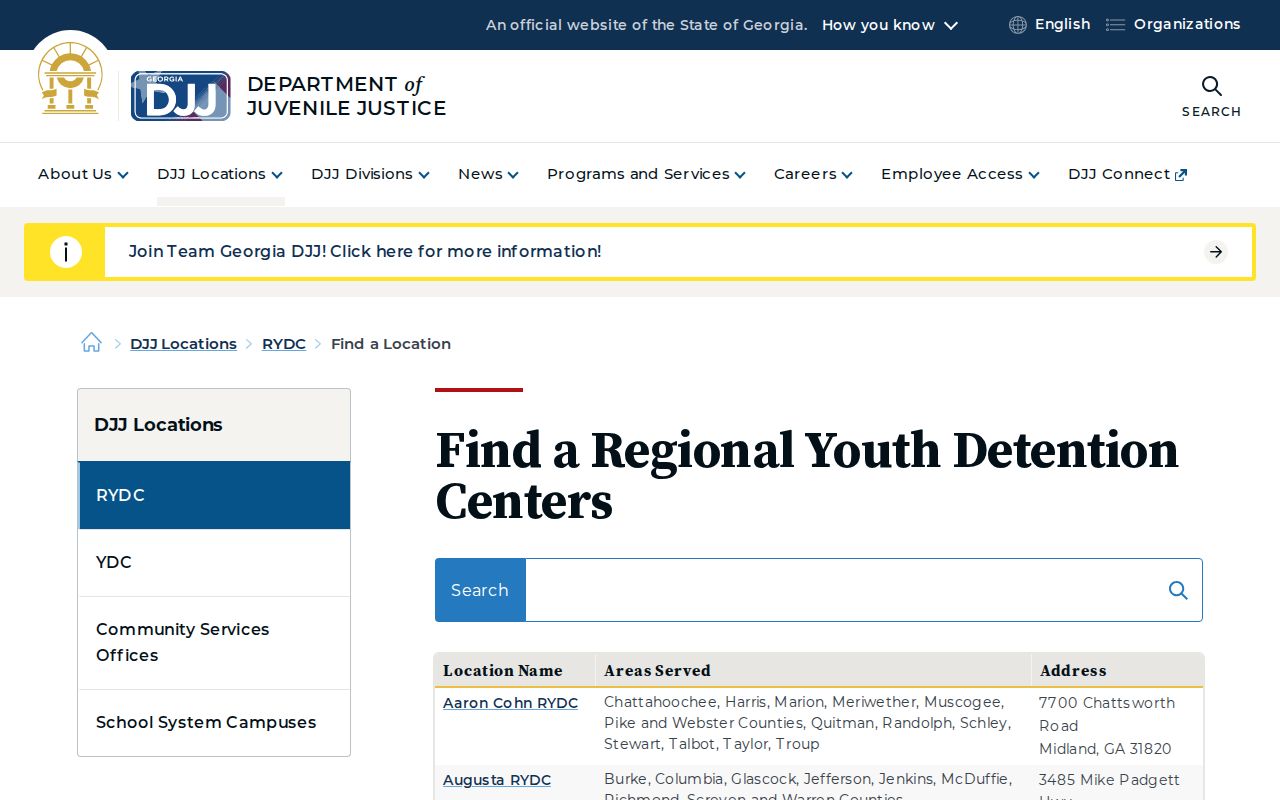
The directory supports the facility's regional role but does not expose youth names, custody status, or release details. For a court record, contact the juvenile court that has jurisdiction. Whitfield County Juvenile Court is listed by the Sheriff's helpful-numbers page at 706-278-6558, but another served county's court may control the case.
Elbert Shaw Regional Role
Elbert Shaw serves more than Whitfield County. DJJ identifies its service area as Catoosa, Dade, Fannin, Gilmer, Murray, Pickens, and Whitfield counties. The facility's Dalton address does not mean every youth there has a Whitfield County case. The court of origin and the assigned DJJ staff matter when an authorized person needs case information.
A regional youth detention center is also distinct from a Youth Development Campus. DJJ explains that an RYDC is a secure short-term center for youth awaiting trial or a later program or placement. A Youth Development Campus is a secure long-term setting for youth committed or sentenced to DJJ custody by juvenile courts. A transfer between those settings is not the same as release from state juvenile custody.
- RYDC
- A secure short-term juvenile center tied to court proceedings or a pending placement.
- Authorized party
- A parent, guardian, attorney, court participant, or other person legally allowed to receive case information.
- Placement
- A court or DJJ-approved setting that may follow detention and is not always a return home.
Whitfield Juvenile Record Limits
Juvenile matters are treated differently because the record concerns a minor and may contain protected family, education, medical, placement, or court information. An adult release database is designed around public criminal-justice records. It should not be repurposed to infer a youth's custody status, location, or release date.
Even a general open-records law does not make every agency record public. Confidentiality rules and exemptions can limit access, redact identifying details, or reserve records for a party to the case. An authorized requester should state the connection to the youth and ask the responsible office which form, proof of identity, or court authorization is required.
Public users can rely on the facility listing for general facts only. Case-specific answers belong with DJJ, the juvenile court, counsel, a parent or guardian, or another authorized party.
Elbert Shaw Transition Planning
A youth leaving secure detention may still be under a court order, DJJ supervision, a community-program plan, or another placement. The word release can therefore describe the end of one facility stay without describing the end of the juvenile case. Authorized family members should obtain instructions directly from the case team.
Questions may include who may pick up the youth, where the youth must report, what documents are needed, and whether another program starts at once. These are individual case matters. Facility and DJJ staff can provide only the information allowed for that caller. Counsel can explain an order, while the court clerk can identify the proper filing or hearing record available to a party.
Do not rely on rumor, social media posts, or an adult roster's lack of a name. Those sources cannot establish a protected juvenile transition.
Adult and Juvenile Systems
Whitfield County Jail is an adult county facility run by the Sheriff's Office. Elbert Shaw RYDC is a juvenile regional facility run by DJJ. Their records, populations, and release routes are not interchangeable. The Whitfield County adult release resource applies to adult county, state, federal, and immigration paths, not to a public search for youths.
| Question | Adult county jail | Elbert Shaw RYDC |
|---|---|---|
| Operator | Whitfield County Sheriff's Office | Georgia DJJ |
| Public locator | P2C may show adult custody entries | No public youth-release search should be encouraged |
| Case route | Sheriff records and adult courts | DJJ, juvenile court, counsel, authorized party |
| Departure meaning | Community release or agency transfer | Home, program, supervision, or another placement as ordered |
Using the correct route protects the youth and gives authorized people a better chance of reaching the office that can lawfully answer.
Elbert Shaw Court Jurisdiction
Elbert Shaw's seven-county service area makes jurisdiction a key first question. The youth may be held in Dalton while a juvenile court in Catoosa, Dade, Fannin, Gilmer, Murray, Pickens, or Whitfield County controls the case. Facility location alone does not identify the court file. An authorized party should use paperwork from the hearing, counsel, or the assigned case worker to identify the right county and case number.
The juvenile court can address its own orders and hearing records. DJJ can address the custody and placement functions it manages. Facility staff can address permitted operational questions. Each office may require proof of identity or legal authority before discussing an individual youth. Calling the correct office reduces the risk of disclosing private details to a person who is not entitled to them.
If the case arose in Whitfield County, the local Sheriff's contact list gives Juvenile Court at 706-278-6558. That number is a routing fact, not a public youth locator. Callers should ask what secure process applies and avoid leaving detailed private information in voicemail unless instructed.
Elbert Shaw Family Preparation
An authorized parent or guardian may need to plan for transportation, identification, medication, school records, or a reporting appointment. The exact requirements come from DJJ, the court order, and the assigned program. They should not be inferred from adult jail release practices. Confirm who may receive the youth, where the handoff occurs, and which documents must be presented before traveling.
Medication and care questions can involve protected health information. Use the contact method DJJ provides and follow staff directions for transferring prescriptions or treatment details. Education and program records can carry their own access limits. Counsel or the case team can help identify who has authority to receive each kind of record.
A planned move to a community program is not necessarily the end of DJJ or court involvement. Reporting rules may begin as soon as secure detention ends. Families should keep the written instructions, names of assigned staff, and court dates together. If instructions conflict, ask counsel or the issuing office to resolve the conflict rather than relying on a public web search.
Elbert Shaw Public Information
General facts about Elbert Shaw remain suitable for public use. DJJ publishes the facility name, location, phone number, center type, and regional role. Those facts help families and professionals reach the right agency without exposing a youth's identity. The official DJJ location page should be favored over an unofficial directory because agency details can change.
Case-specific facts are different. A youth's presence, alleged conduct, court status, treatment, placement, and departure plan may be confidential or limited to parties. The lack of a public result does not establish that the youth was released, transferred, or never held. It reflects the fact that juvenile systems do not operate as adult public rosters.
Public records staff can explain whether a general policy or non-identifying agency record is available. For an individual case, the proper route stays with DJJ, the juvenile court, counsel, a parent or guardian, or another person with documented authorization.