
Whitfield Parole and Probation Compared
Parole and probation can both place a released person under rules in the community, but the source of authority is different. The Georgia State Board of Pardons and Paroles decides whether an eligible state prisoner will leave prison on parole. The Georgia Department of Community Supervision, or DCS, then handles day-to-day supervision. A Whitfield County court imposes probation as part of a criminal sentence, often without a state prison release at all. DCS also supervises many probation cases.
That distinction changes the record trail. A parole inquiry begins with the Parole Board's public tools and GDC identity data. A probation inquiry begins with the Whitfield court case and may continue with DCS. The county jail roster is a current-custody tool. It does not establish either form of supervision once a person has left the jail.
| Point | Parole | Probation |
|---|---|---|
| Who orders it | State Board of Pardons and Paroles | Sentencing court |
| What comes first | Part of a prison term | A court sentence, sometimes instead of prison |
| Public check | Parolee Database and Board records | Whitfield court docket and DCS confirmation |
| Local supervision | DCS Dalton Field Office | DCS Dalton Field Office when assigned |
| End event | Parole expiration or discharge | Probation completion or court discharge |
- TPM
- Tentative Parole Month, a possible future month that is not a final release order.
- Discharge
- The formal end of custody or supervision obligations.
- Absconder
- A person alleged to have stopped reporting or otherwise left supervision without authorization.
- Revocation
- A formal process that may return a person to custody after a proven violation.
Verify Whitfield Post-Release Supervision
Start with a firm identity. Similar names, aliases, and different birth dates can produce a false match. For a person who served a Georgia prison sentence, use the Parole Board's Parolee Database. Search results may provide a parole end date, office, office phone, primary offense, and pardon information. For a person who may be on probation, use the Whitfield court record to locate the sentence and probation terms. A release event by itself does not prove supervision.
- Confirm the full name and, when available, a GDC or case identifier.
- Determine whether the person left county jail, GDC prison, or another system.
- Check the Parolee Database for active or past parole. For an incarcerated person, use the TPM tool only as a prospective Board record.
- Review the Whitfield Superior Court criminal case for probation language and sentence changes.
- Use the listed office or DCS locator to confirm where supervision is assigned. Ask about a public record, not private case details.
The Inmate TPM Lookup accepts a six-digit inmate number, GDC ID, or personal data. It concerns parole consideration before release. A TPM can be changed, postponed, or cancelled during final review, so it should never be reported as the actual day a person left custody.
Whitfield Parole Decisions and Hearings
Georgia does not provide a simple Whitfield County parole hearing calendar. The Board uses a file-review process. Eligible GDC inmates are considered automatically, investigators build the file, hearing examiners apply guidelines in non-life cases, and Board members vote independently until a majority is reached. The Board may deny parole or set a TPM. Near that month, a final review determines whether an actual parole date will be set.
The Georgia parole process also explains that a future TPM is not a promise. Misconduct, an unmet condition, new information, or another legal hold can affect the result. Non-life cases denied parole are reconsidered at least every five years after eligibility, while life-sentence reconsideration intervals may extend to eight years. The Board, not the Dalton field office, makes these release decisions.
Most parole-eligible inmates become eligible after one-third of the term. That does not apply to every sentence. Certain serious violent felony sentences for crimes committed on or after January 1, 1995 require service of the full non-life prison term. Fourth-felony recidivist and other statutory restrictions can also remove parole eligibility. The governing offense date and sentence must be checked before drawing a conclusion.
Whitfield Supervision Office Details
After release to Whitfield County, the practical reporting point is the DCS Dalton Field Office. It serves Whitfield County, Murray County, and the Conasauga Judicial Circuit. Office staff supervise assigned cases; they do not replace the Parole Board's decision record or the court's sentencing docket.
230 Brickyard Road
Dalton, GA 30720
Phone: 706-272-2306
Fax: 706-403-2536
Monday-Friday, 8:00 a.m.-4:30 p.m. Eastern
Callers should have the person's correct name and enough detail to distinguish the case. Public databases may show an office or end date, while reporting schedules and case-specific conditions may not be public. If the online result conflicts with a court order, obtain the originating record rather than guessing which entry is newer.
The manifest image below comes from the official DCS office page. View the Dalton Field Office source before relying on contact details.
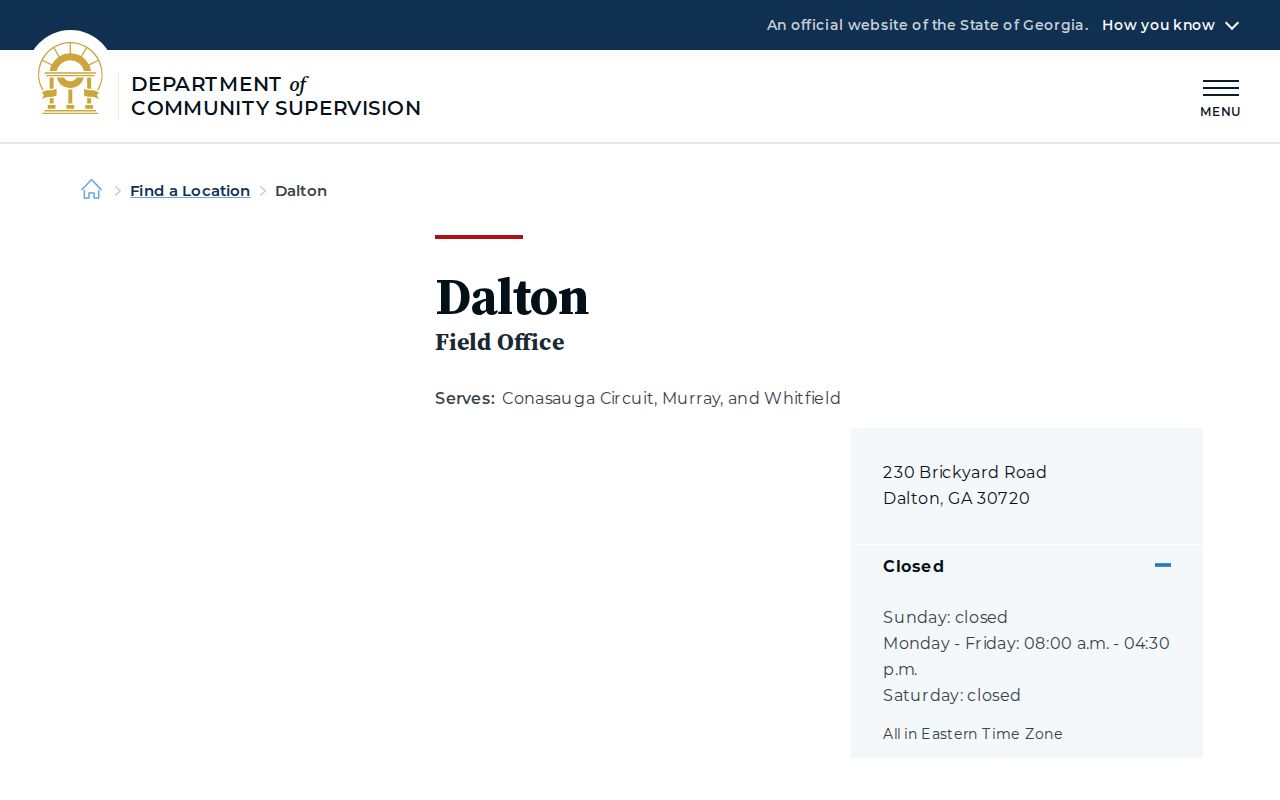
The office listing ties community supervision in Whitfield County to a named local field office rather than to the jail.
Whitfield Reentry and Court Programs
Local supervision is not limited to office reporting. Whitfield Superior Court identifies Domestic Violence Court, Drug Treatment Court, and Mental Health Court among the Conasauga Circuit's accountability courts. These are court programs with their own eligibility and orders. They should not be confused with parole release or assumed to apply to every probation case.
The Whitfield treatment and accountability court page is the local source for program context. The DCS system also operates Day Reporting Centers as structured, nonresidential programs. A court order, supervision plan, or assigned officer determines whether any such service is part of one person's case.
A person can therefore have several linked records after release: a court sentence, a DCS supervision assignment, and, for parole, a Board decision. The Whitfield County released-inmate search explains how the underlying jail release and court disposition fit beside these supervision records.
Whitfield Warrants and Absconder Status
A missed report does not by itself prove that a public warrant exists. DCS can respond to alleged violations through graduated sanctions, court action, or a revocation process, depending on the authority and facts. An absconder label generally means the supervising agency alleges that the person stopped reporting or cannot be located. It is not the same as a new conviction.
Use an official warrant or court source for confirmation. The Whitfield court docket may show a filed petition, hearing, or order. The Parolee Database can identify the parole office, but a missing database result does not prove that supervision ended. Names change, records update, and restricted case information may require contact with the originating office.
The active sex-offender list uses a narrower registration definition of absconder, including failure to register after release or at a required anniversary. That list applies only to people subject to registration. It is not a general parole, probation, or released-inmate roster.
Note: Verify a warrant or revocation through the issuing court or supervising agency before treating an online status as current.
Property After Whitfield Release
The Sheriff's divisions information adds a practical limit for families dealing with documents or property around release. Inmate mail is scanned through an off-site address, direct mail to the detention facility is not accepted under the ordinary mail process, and legal mail follows separate rules. Outside property generally cannot be handed directly to a person in custody, apart from limited medical items.
After release, contact the detention facility before attempting a pickup or delivery. Do not assume that DCS holds jail property or that a supervision officer can resolve a detention-property issue. The Sheriff's divisions page is the source for mail, property, detention, and Records Division procedures.
Release paperwork should be kept because it may state the court, next reporting step, or receiving agency. For parole, the Board and DCS records address supervision. For probation, the sentencing order controls. For jail property, the Sheriff's facility remains the correct contact.
Whitfield Supervision Completion Records
Supervision ends through an official event, not simply because a projected end date arrives. Parole may expire or be discharged through the Board's process. Probation may end by completion, court order, early termination, or another disposition reflected in the court file. A database end date is useful, but the final order or agency record is stronger evidence.
Request the court disposition when probation is at issue. For parole, use the Board record and, if needed, its customer service call center at 404-656-4661. The DCS Dalton office can identify the local supervision channel, though disclosure limits still apply. Georgia VINE is a custody and notification service, not a complete history of supervision discharge.
A transfer between offices is also not a discharge. Confirm whether the record says transferred, expired, discharged, revoked, or terminated. Each term describes a different event and can lead to a different agency for the next check.
Public Record Search
Sponsored Results