
Whitfield Projected Versus Actual Release
A projected date is an estimate based on the record as it stands. An actual release date records the day custody ended. In Whitfield County jail, an expected date may reflect bond processing, time served, a short local sentence, or a court order. In GDC custody, the record may show a sentence end date, maximum release date, or release date. The Parole Board may show a Tentative Parole Month, called a TPM.
Each field has a different legal role. Georgia's maximum release date is the date a person would leave GDC if the whole term were served apart from parole decisions. A sentence end date reflects the court term plus non-running time and earned-time effects. A TPM is a possible parole month and remains subject to final Board review.
A person awaiting trial usually has no sentence-based release date. Bond can be set or changed, charges can be dismissed, or a judge can order release. The jail and court docket are the right sources for that local path, not the GDC offender search.
Find a Whitfield Release Date
Begin by identifying where the person is held. The official Whitfield P2C inmate catalog is the county custody source and may show expected or released-date language on an entry. For a state prisoner, the GDC offender search provides charges, facility location, and release information. A federal sentence belongs in the BOP locator, not either local system.
- Confirm the person's full name, birth date, booking number, GDC ID, or other reliable identifier.
- Check Whitfield P2C for county custody. If the person is pretrial, review the court docket for bond and hearing orders.
- Use GDC Find an Offender for a Georgia prison sentence. Read the label beside each date.
- For parole consideration, use the Parole Board TPM lookup and treat the month as tentative.
- Ask the jail, court clerk, GDC records unit, or Parole Board to resolve a conflict between records.
The statewide Find an Offender service is not a historical county-jail release archive. Likewise, a live jail roster is not the best record after release. For a prior local release, request the booking and release event or check the Whitfield court disposition. The broader Whitfield County released-inmate search explains that record chain.
Whitfield Jail Dates Follow Courts
County jail dates are driven by custody events rather than a single published formula. A person may leave after bond is posted, a judge orders release, time is served, a sentence ends, charges are dismissed, or another agency accepts a transfer. Whitfield sources do not publish a county good-time or weekend-release formula. No such rule should be assumed.
First appearance is especially relevant to short-term estimates. WCSO says most qualifying new arrests receive a first appearance within 48 hours of booking, generally at 2:00 p.m. except Sundays and county holidays. The hearing can establish or clarify bond, but it does not guarantee that release processing will finish at a set hour.
Use the Whitfield Magistrate Court record for early bond activity and the Superior Court criminal record for felony sentences and later orders. A P2C expected date may help orient the search, yet the actual release record is stronger after custody ends. If a person leaves the roster before the expected date, ask whether the event was community release or transfer.
Note: Whitfield research found no separate county formula for jail credits, so confirm each local sentence with the jail and court.
Georgia Sentence Computation in Whitfield
Georgia Rule 125-2-4-.04 makes the crime date a key factor in sentence computation. For crimes on or after January 1, 1984, the rule describes straight-time service, with beginning and ending dates basically set by the courts. Non-running time, overlapping terms, court amendments, and earned credits can still affect the calculation.
Georgia does not publish one general 85-percent rule for every state prisoner. Most parole-eligible inmates become eligible after one-third of the sentence, but eligibility is not release. Certain serious violent felony non-life terms for crimes committed on or after January 1, 1995 require service of 100 percent of the imposed prison term. Other mandatory and recidivist limits may also apply.
| Date or term | Meaning | Best source |
|---|---|---|
| Expected jail release | Local estimate tied to custody and court events | Whitfield jail and court |
| Sentence end date | Effective end after sentence computation effects | GDC |
| Maximum release date | Full GDC term apart from parole | GDC |
| TPM | Tentative month for possible parole | Parole Board |
| Actual release date | Recorded day custody ended | Releasing agency |
Whitfield Performance Incentive Credit
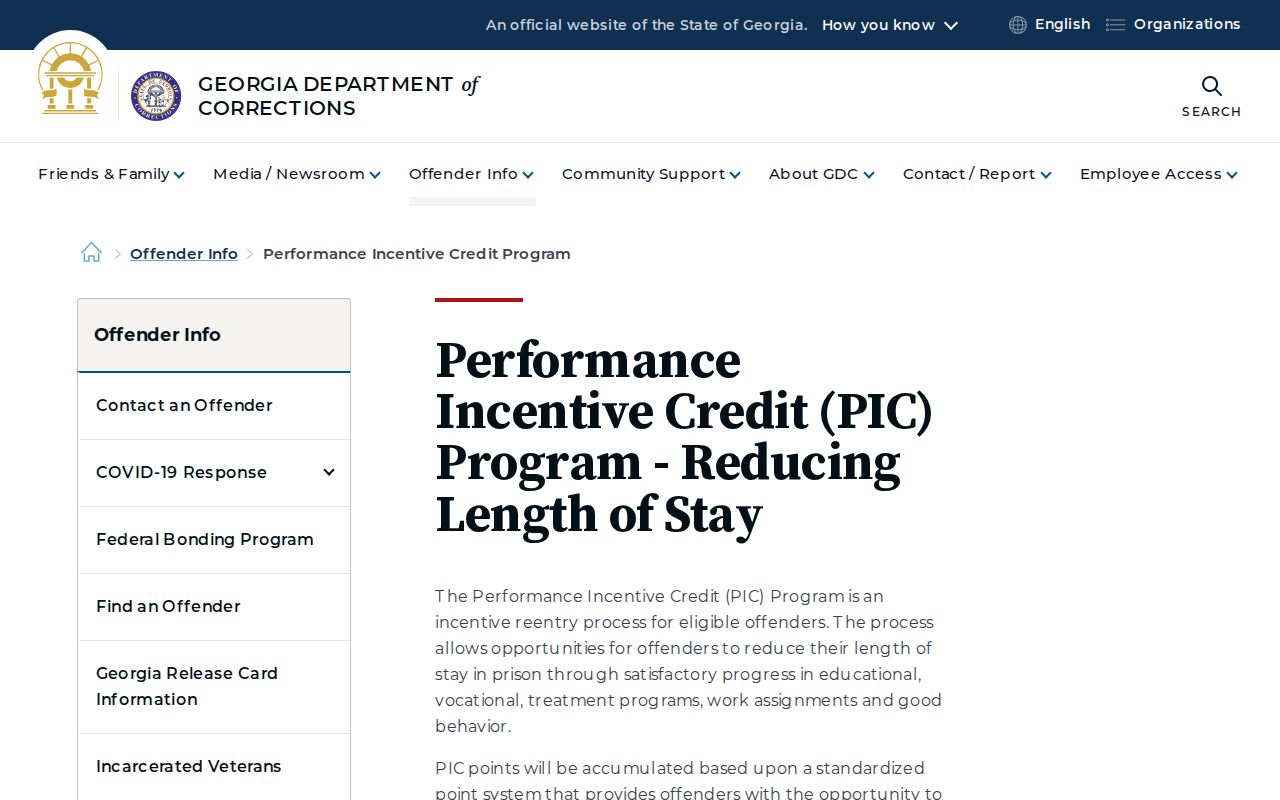
Performance Incentive Credit, or PIC, is the main current GDC reduction process documented in the research. Eligible offenders can earn points through satisfactory progress in education, vocational work, treatment, work assignments, and good behavior. GDC says up to twelve points may support one to twelve months off a TPM or maximum release date.
The program does not cover every sentence. Exclusions include a death sentence, a term of two years or less, life terms, and offenses with non-parole-eligible or minimum mandatory requirements. O.C.G.A. § 42-5-101 authorizes work incentive credits for qualifying felony prison terms other than life imprisonment and allows GDC to report credits to the Parole Board.
The official GDC PIC page is shown in the subject-matched image below.
The program can move a qualifying calculation, but the public date should still be checked again after GDC or the Board applies the credit.
Changes to Whitfield Release Dates
A projected release date changes only through an event recognized by the agency that computes it. Rumor, an old court calendar, or a family estimate cannot alter the official record. The most common causes arise from sentence administration, another legal authority, or parole review.
| Factor | Possible effect | Where to verify |
|---|---|---|
| Earned PIC | May reduce TPM or maximum release date | GDC and Parole Board |
| Discipline | May delay eligibility or affect Board review | GDC |
| Detainer or warrant | Can cause transfer instead of community release | Holding and receiving agencies |
| Amended court order | Can alter the controlling sentence | Sentencing court and GDC |
| Parole decision | May set, postpone, cancel, or deny release | Parole Board |
| Non-running time | Can extend sentence computation | GDC records |
A Whitfield jail release can also become a transfer to GDC, another county, or a federal agency. That event ends local custody but does not mean the person is free. Follow the receiving system before stating that release occurred to the community.
Whitfield TPM Is Not Release
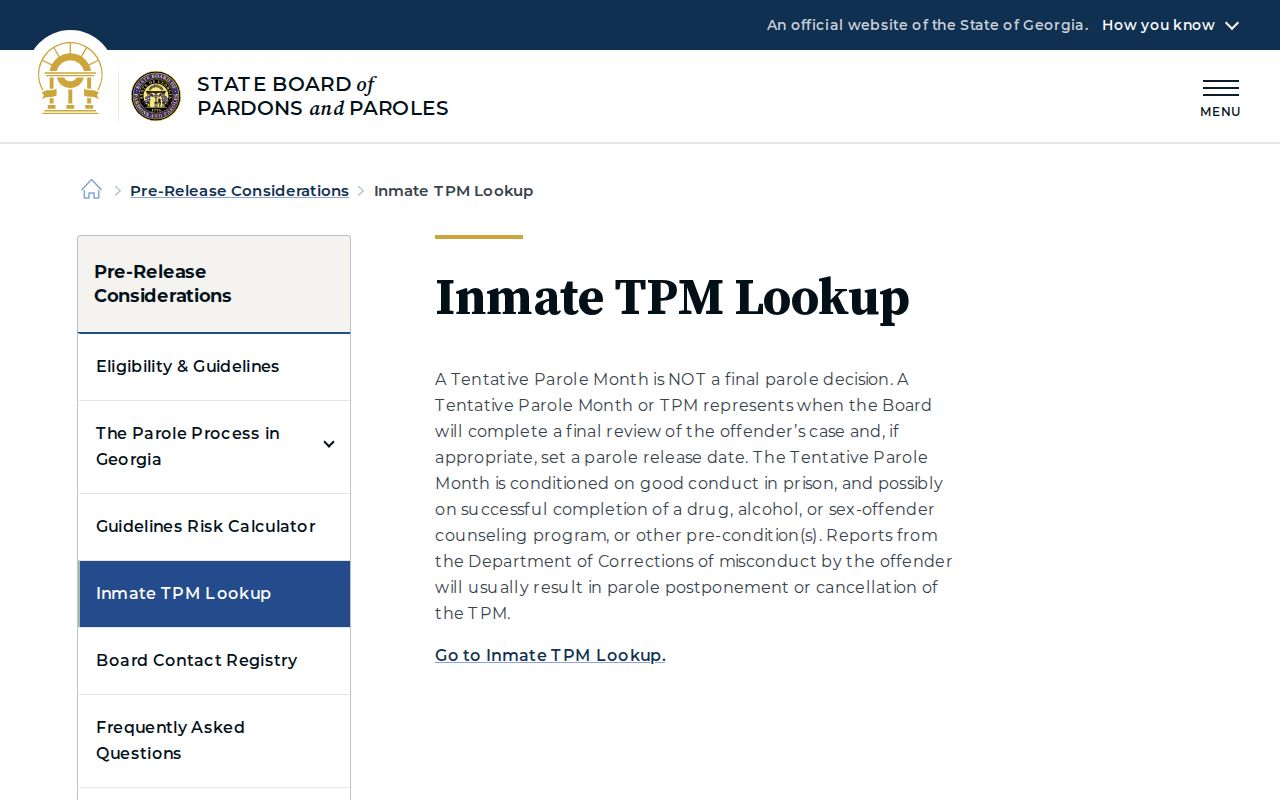
The Parole Board TPM explanation is explicit that a TPM is not a final decision. Board members review the file again near the tentative month. Misconduct, new information, or an unmet condition can lead to a postponement or cancellation.
The source page is represented by the approved manifest image below. It is useful when interpreting the lookup result, not as proof of an actual release.
After a final parole date is set, confirm the custody change through GDC and use the VINELink Release Check for notifications where available. VINE is not a complete sentence-computation record and can lag behind the originating agency.
Confirm Whitfield Actual Release
After the predicted day or month, return to the source that held the person. For county custody, request the release event from the Sheriff's Records Division or inspect the court order. For GDC, check the offender entry and, when needed, write Inmate Records and Information at PO Box 1529, Forsyth, GA 31029 or call 404-656-4661.
For parole, distinguish a final release decision from the later start of supervision. For federal custody, use the BOP locator. For an ICE handoff, use the ICE locator or appropriate federal contact. A past date with no current facility may show release from that one system while another agency still holds or supervises the person.
County records can also resolve a date that changed at the last moment. Ask for the booking number, release date and time, release type, and destination or receiving agency where those fields are public. A court order can explain why the jail acted, while the jail event shows when local custody actually ended. Neither should be replaced by a social post or an estimate from an earlier hearing.
For GDC records, compare the status with the facility and sentence fields. A date in the future may be an estimate. A past date paired with a released or discharged status is stronger, but parole or another form of supervision may follow. If the record shows a transfer, continue with the receiving facility. A transfer date is an exit from one location, not release from all legal custody.
Keep a copy of the result, the date checked, and the labels shown. Date fields can be updated. The releasing office's record remains the best proof of what happened and where the person went next.
Whitfield Date Record Conflicts
Conflicts often result from comparing fields that measure different events. A court sentence date begins a legal term, a jail expected date estimates local processing, a GDC maximum release date assumes service of the full state term, and a TPM reflects possible parole. Put each date beside its label and source before deciding that one is wrong.
Identity errors are another cause. Search spelling variations, compare birth information and identifiers, and avoid merging two people with similar names. The Whitfield court search itself warns that spelling and online reliability require care. If an agency corrects an entry, retain the newer response with its access date and discard unsupported conclusions drawn from the old screen.
A court clerk can explain the filed order, but the holding agency computes and records its custody event. The Parole Board controls parole decisions. Direct a correction to the office that owns the disputed field instead of asking one agency to amend another agency's database.
Public Record Search
Sponsored Results